I recently learned about the Fall of Freedom, a “nationwide wave of creative resistance” to the current government. While many events happened this past Friday and Saturday (November 21 and 22), there are quite a few that used the weekend to kick off exhibits and performances that are ongoing. Use their interactive map to find out what’s happening near you.
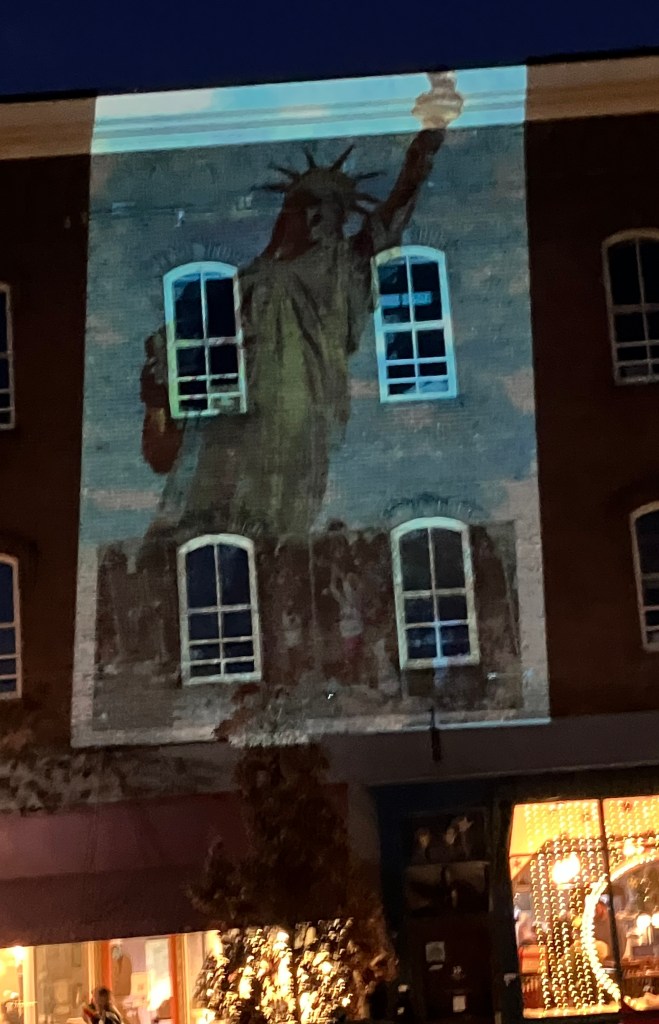
After using this map myself, I ventured north late Saturday afternoon to the quaint little town of Shelburne Falls, Massachusetts. A group called the Artivists was projecting protest-themed artwork on a few buildings around the downtown. I got there a little before sundown and had a nice late afternoon/early evening walk while waiting for it to get sufficiently dark. I had just about given up when I spotted a large Statue of Liberty being projected on the wall across the street from me. I stopped and was treated to a whole slideshow of artworks.
It felt like a very grassroots event, and looking at the calendar, I would say that is the case across the nation, but scrolling through the list of so many performances, crafts sessions, museum exhibits, and readings helps restore my faith in America and humanity just a bit. If you missed the events this weekend, don’t worry, I have a feeling there will be more. In the meantime, here’s a list of inspiring picture books about artists who used their art to advocate for justice and social change.
Start with The Artivistby Nikkolas Smith (Kokila, 2023, 40 pages, all ages). Nikolas Smith describes the intersection of art and activism and invites readers of all ages to become activists.
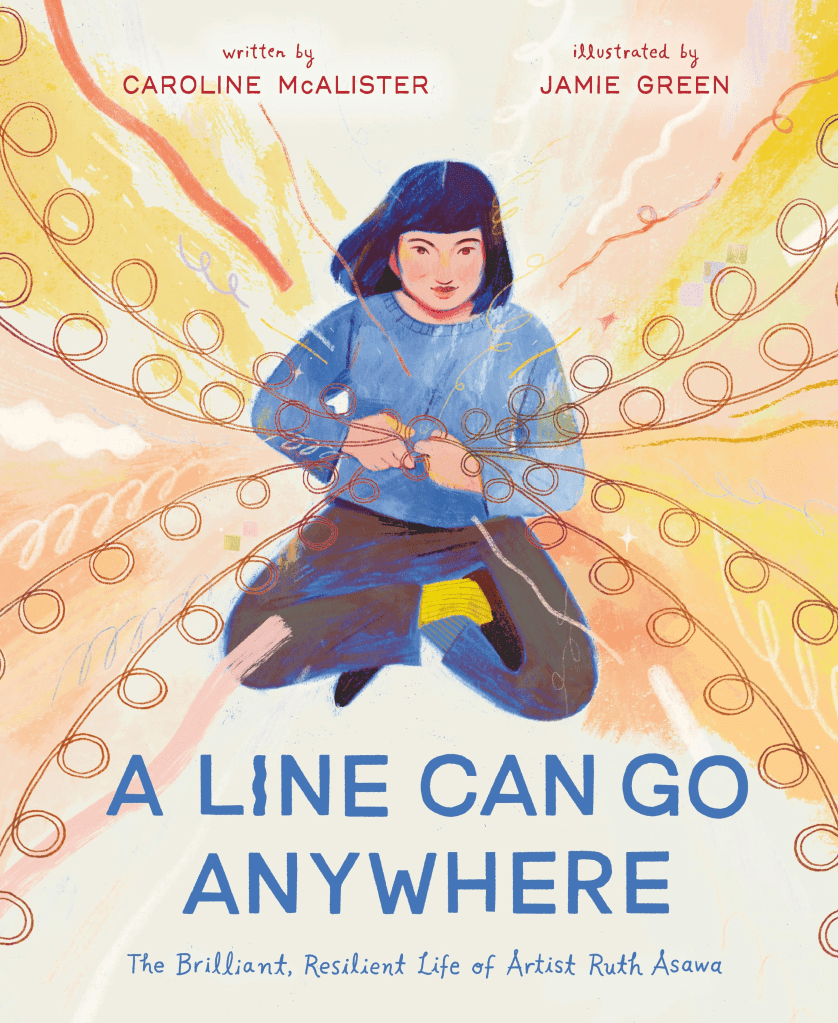
A Line Can Go Anywhere: The Brilliant, Resilient Life of Artist Ruth Asawaby Caroline McAlister, illustrated by Jamie Green (Roaring Brook Press, 2025, 40 pages, grades 2-5). Ruth Asawa drew on her own experiences in a World War II internment camp to create a memorial to those Japanese Americans who were similarly imprisoned.
I’m Gonna Paint! Ralph Fasanella, Artist of the People by Anne Broyles, illustrated by Victoria Tentler-Krylov (Holiday House, 2023, 48 pages, grades 1-5). Ralph created his first art at the age of 31 as therapy for a hand injury, but soon he was painting the working people and political messages that he had learned about through his union organizing. Today his work can be seen in union halls and subway stations, as well as museums.
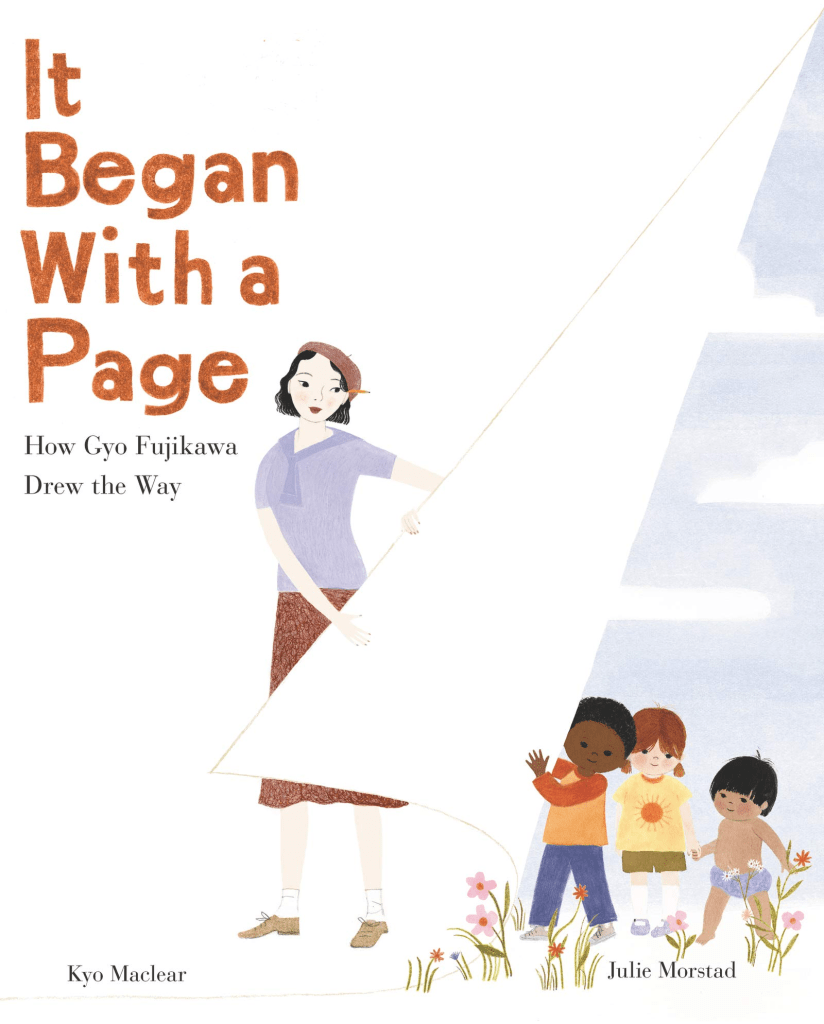
It Began With a Page: How Gyo Fujikawa Drew the Way by Kyo Maclear, illustrated by Julie Morstad (HarperCollins, 2019, 48 pages, grades 2-5). After experiencing prejudice and discrimination as part of the Japanese American community during World War II, Gyo Fujikawa went on to create one of the first children’s books portraying babies with different skin colors.
Gordon Parks: How the Photographer Captured Black and White America by Carole Boston Weatherford, illustrated by Jamey Christoph (Albert Whitman and Co., 2015, 32 pages, grades 1-5). Starting with his work for the Farm Security Administration during the Great Depression, Gordon Parks traveled around America, capturing the lives of Black people in cities like Chicago and Washington, D.C. with his camera, and using his photographs to work for human rights.
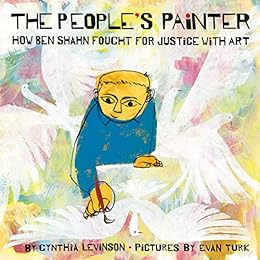
The People’s Painter: How Ben Shahn Fought for Justice with Art by Cynthia Levinson, pictures by Evan Turk (Abrams Books for Young Readers, 2021, 48 pages, grades 1-5. Starting with 23 paintings to document his outrage over the trial of Sacco and Vanzetti, Ben Shahn went on to paint scenes from the Great Depression, the civil rights movement, and the Vietnam War.
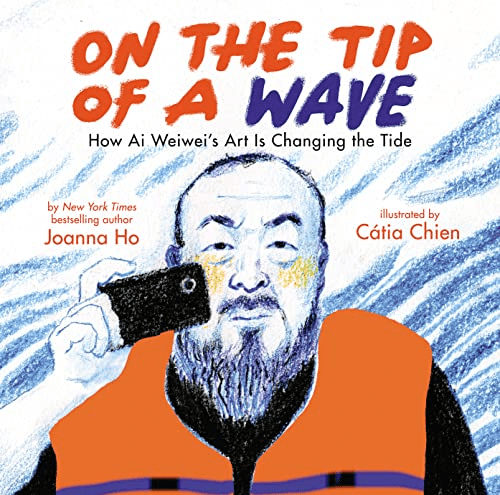
On the Tip of a Wave: How Ai Weiwei’s Art Is Changing the Tide by Joanna Ho, illustrated by Catia Chien (Orchard Books, 2023, 48 pages, grades 3-8). After a childhood spent in a labor camp in China due to his poet father’s writings, Ai Weiwei has gone on to create art to draw attention to the plight of refugees, most famously an installation of Greece made of life jackets left behind by refugees.
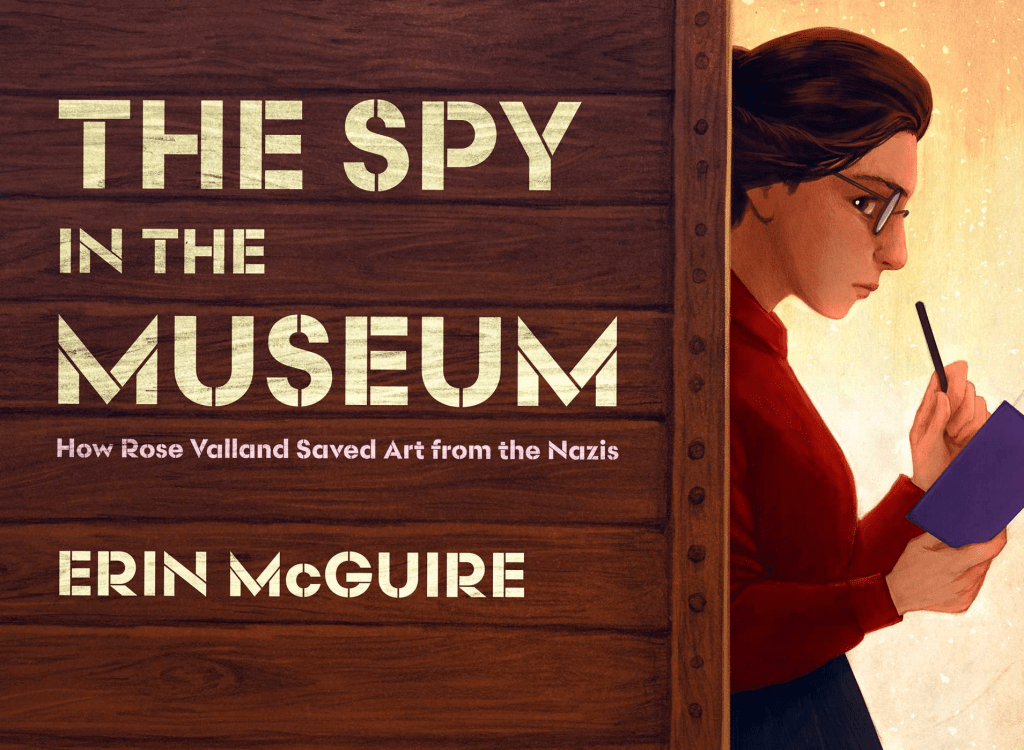
The Spy in the Museum: How Rose Valland Saved Art from the Nazis by Erin McGuire (Beach Lane Books, 2025, 40 pages, grades 2-5). Although she wasn’t an artist herself, Rose Valland’s resistance work at Paris’s Jeu de Paume Museum during the Nazi invasion saved many valuable works of art from destruction.
Veterans Day originated as Armistice Day, celebrating the end of World War I, when an armistice was declared that began at the eleventh hour on the eleventh day of the eleventh month. In 1954, President Dwight Eisenhower changed the name to All Veterans Day, later shortened to Veterans Day, a holiday to honor veterans of all wars, although it’s still called Armistice Day in France and Remembrance Day in the United Kingdom, Canada, and Australia.
While I’m on board to honor the contributions of veterans, wouldn’t it be lovely to see Veterans Day rendered obsolete someday by the cessation of war? To paraphrase John Lennon, you may say I’m a dreamer, but a trip to the Peace Memorial Park in Sherborn, Massachusetts revealed that I’m not the only one.
The Peace Abbey was founded in 1988 by educator Lewis Randa as a resource to promote peace, nonviolence, and animals rights through public art, memorials, and educational programs. Although financial difficulties forced them to close their doors and sell their buildings in 2012, Lewis and his colleagues continue to work for a variety of peace-related causes, and the outdoor peace memorials created by the Abbey remain open to the public.
At the center of the memorial are statues of Mahatma Gandhi and Emily the cow. Emily escaped from a Hopkinton, Massachusetts slaughterhouse in 1995, and after evading capture for 40 days, found a home at the Peace Abbey where she lived until her death in 2003. Her statue is a tribute to vegetarianism, with about a dozen plaques with quotes on the subject surrounding her, and it also marks the final resting place of her remains.
The Gandhi statue is encircled by low brick walls, each one containing half a dozen plaques commemorating peace activists from a variety of countries, backgrounds, and eras: George Harrison, Maria Montessori, Johnny Appleseed, Jesus of Nazareth, Anne Frank, and Muhammad Ali, to name a few. Each plaque includes information on what the person did, the years they lived, and a quote.
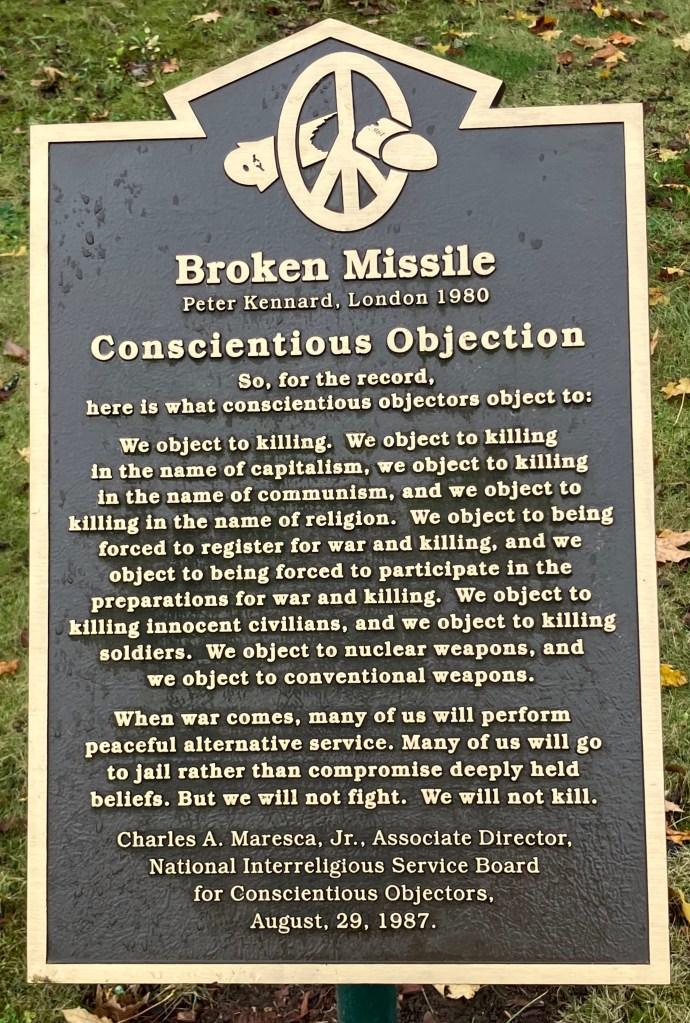
At the end of each wall is a plaque with a prayer for peace from different religious traditions. In addition, memorials are scattered about for war correspondents, unknown civilians killed in war, victims of violence, conscientious objectors, and Princess Diana, with an acknowledgement of her work to rid the world of land mines.
It’s a pretty quick visit, but it felt to me like a good starting place for a much deeper dive into the work of the peacemakers who are commemorated here. I was familiar with some of them, but many of the names were new to me. From what I know of the ones I recognized, I’m sure that each one has an interesting story to learn about.
John F. Kennedy once said, “”War will exist until that distant day when the conscientious objector enjoys the same reputation and prestige that the warrior does today.” Perhaps taking a moment on Veterans Day to honor those peacemakers and conscientious objectors in the same way we do war veterans will bring that day closer.
Books to Read
There are many books on peacemakers and activists. Here are a few to sample.
Putting Peace First: 7 Commitments to Change the World by Eric David Dawson (Viking Books for Young Readers, 2018, 160 pages, grades 5-9). At the age of 18, Eric David Dawson founded the nonprofit Peace First to help young people create a more peaceful world today. This handbook helps put his ideas into action.
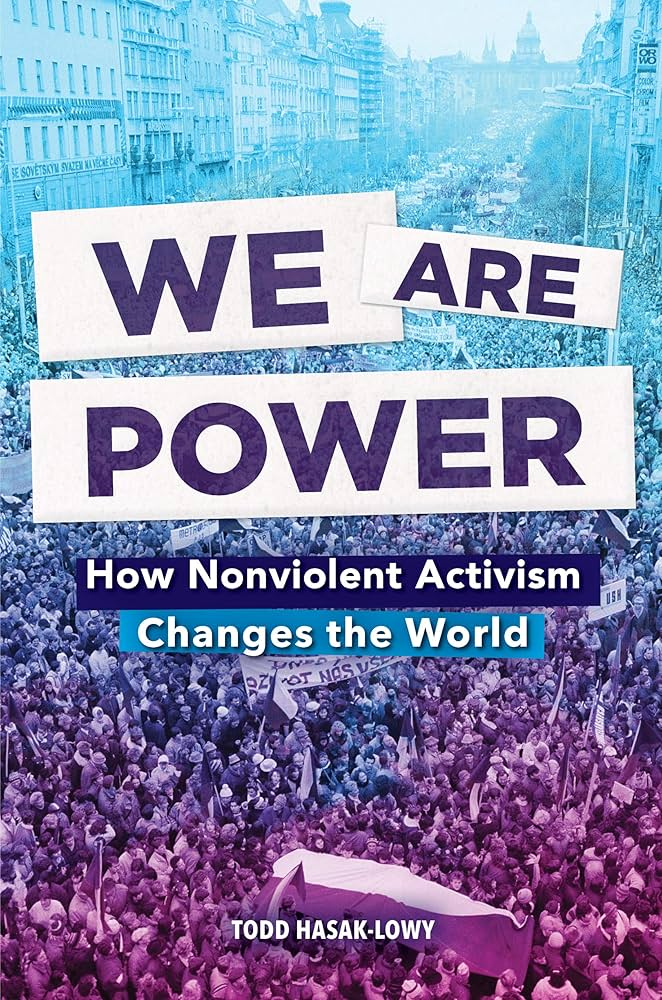
We Are Power: How Nonviolent Activism Changes the World by Todd Hasak-Lowy (Abrams Books for Young Readers, 320 pages, grades 5-9). An introduction to how nonviolent activism can bring about real changes, with stories of people who have used those strategies successfully.
Walking Toward Peace: The True Story of a Brave Woman Called Peace Pilgrim by Kathleen Krull, illustrated by Annie Bowler (Flyaway Books, 40 pages, ages 4-8). The story of Mildred Lisette Norman, who changed her name to Peace Pilgrim and walked through all 50 states from 1953 until her death in 1981, having conversations with people about creating a more peaceful world.
Peace by Baptiste Paul and Miranda Paul, illustrated by Estelí Meza (North-South Books, 2021, 40 pages, ages 4-8). Simple rhyming text and lush illustrations offer concrete tips for living in peace, both with other humans and with animals. Drawn from the authors’ experiences growing up in war-torn Mozambique.
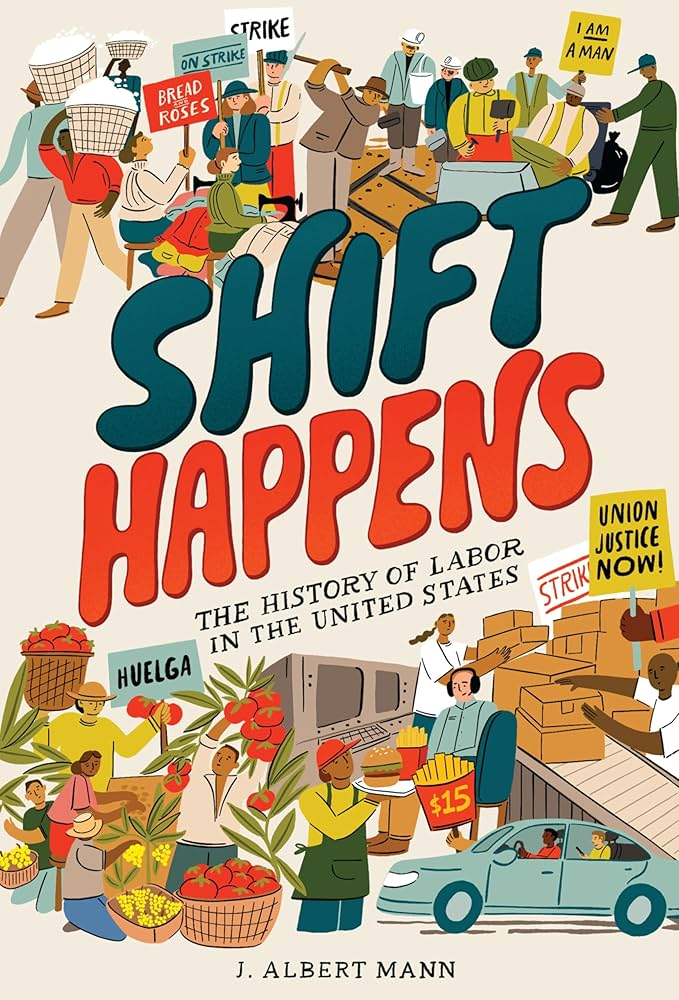
One of the best books I read last year was Shift Happens: The History of Labor in the United States by J. Albert Mann (HarperCollins, 2024, 416 pages). A couple things stood out for me: the discouragingly slow process of the labor movement, where protests have too often been met with violent suppression, and the similarity of stories of low wages, long hours, wealth inequality, and immigrants accused of “stealing” jobs, all of which still resonate today.
In my research into resistance movements for this blog, I learned that what’s generally acknowledged to be the first industrial strike in the U.S. took place not far from me, in Pawtucket, Rhode Island. In May, 1824, the mill owners there announced that they were instituting longer hours with a 25% wage cut. Two days later, 100 women walked off the job, soon joined by other workers in a strike that lasted a week. Unfortunately, there’s no record of the settlement, but the workers returned to their jobs on June 3.
The Blackstone River, which runs from Worcester, Massachusetts to the Naragansett Bay, powered the first cotton mills in the United States, bringing England’s industrial revolution to the New World. I decided to head to Rhode Island to see what I could learn about the workers in these mills in time for Labor Day.
The man who started it all was Samuel Slater, an industrialist born in England in 1768 who served as an apprentice in a British textile mill where he memorized the factory design, immigrated to America, and built his mill in Rhode Island. At the time, it was illegal in England to export their textile technology to another country, so Slater is known as “Father of the American Industrial Revolution” or :”Slater the Traitor” depending on which side of the Atlantic you’re on.
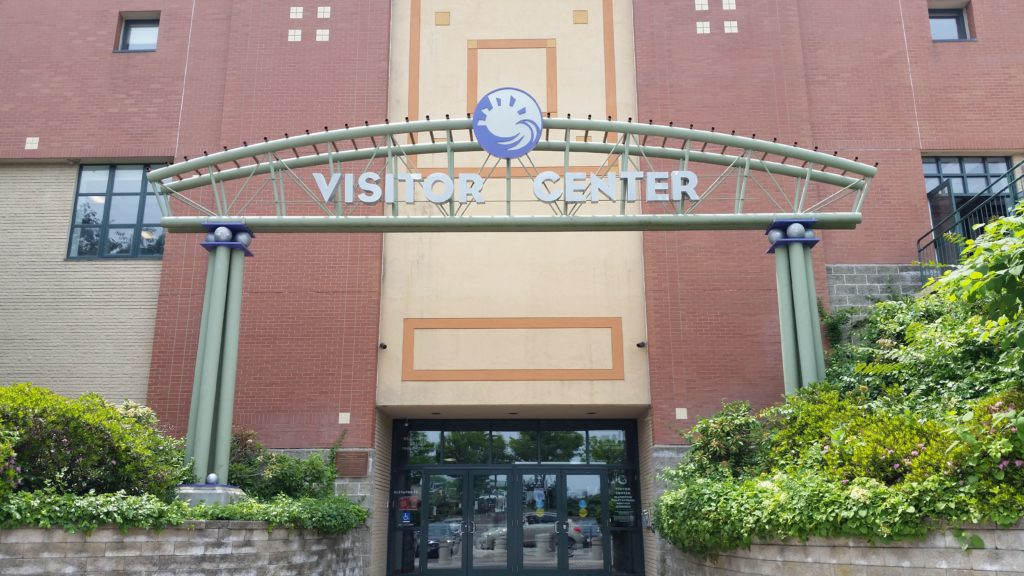
The Old Slater Mill is open for tours, part of the Blackstone River Valley Historical Park. I started my tour at the visitor center there, where I read about the history of the area beginning with the Wampanoag, Nipmuc, and Narragansett people and continuing through Roger Williams’ arrival, the early days as an ironworks, and the textile mill heyday which gradually declined when the steam engine replaced water power.
There’s information about child labor, immigration, and Slatersville, America’s first company town, but not much on the labor movement in general or the 1824 strike in particular. I watched an eight-minute video, and while the lives of workers are described–mill stores where they were expected to buy on credit; churches where they were expected to attend weekly services to learn about timeliness, obedience, and sobriety; and child labor that began in the earliest days of the mill–there wasn’t much about how people pushed back for more rights. There was a brief mention of the 1824 strike, “one of the first by female workers,” and the fact that it led to other actions, but no details.
Slater’s mill is across the street from the visitors’ center, and although I didn’t take the guided tour of Slater’s mill, I watched another short film shown at the entrance. The emphasis was on the mill history and how the machinery worked, but there was an interesting mention of the connection to slavery. 25% of the cotton grown in the southern states went to New England’s textile mills, but Black workers were for the most part excluded from mill jobs. I did find this coloring page that tells a little about the 1824 strike!
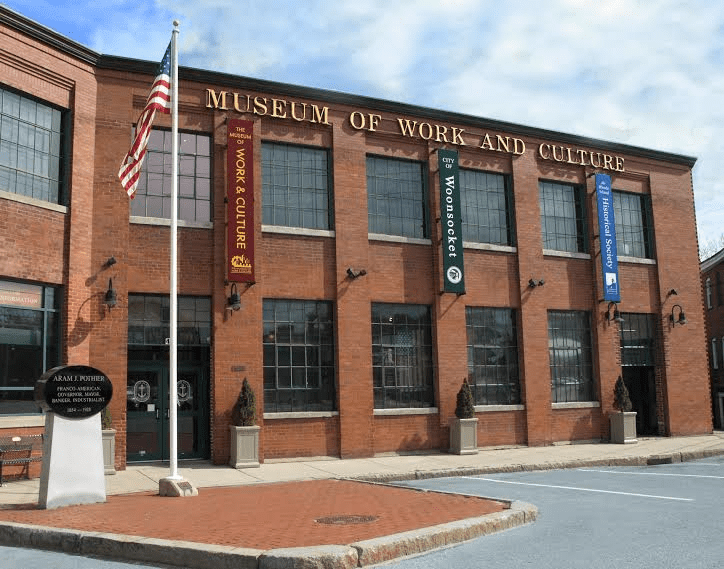
From there I drove about 25 minutes to the Museum of Work and Culture in Woonsocket, where the emphasis was much more on the workers from the area mills, especially those who immigrated from Quebec. “La Survivance” was their name for cultural survival, and this is shown at the museum through replicas of a Quebec farmhouse that people left behind, and a church, a Catholic school room, and the mill floor from their new home.
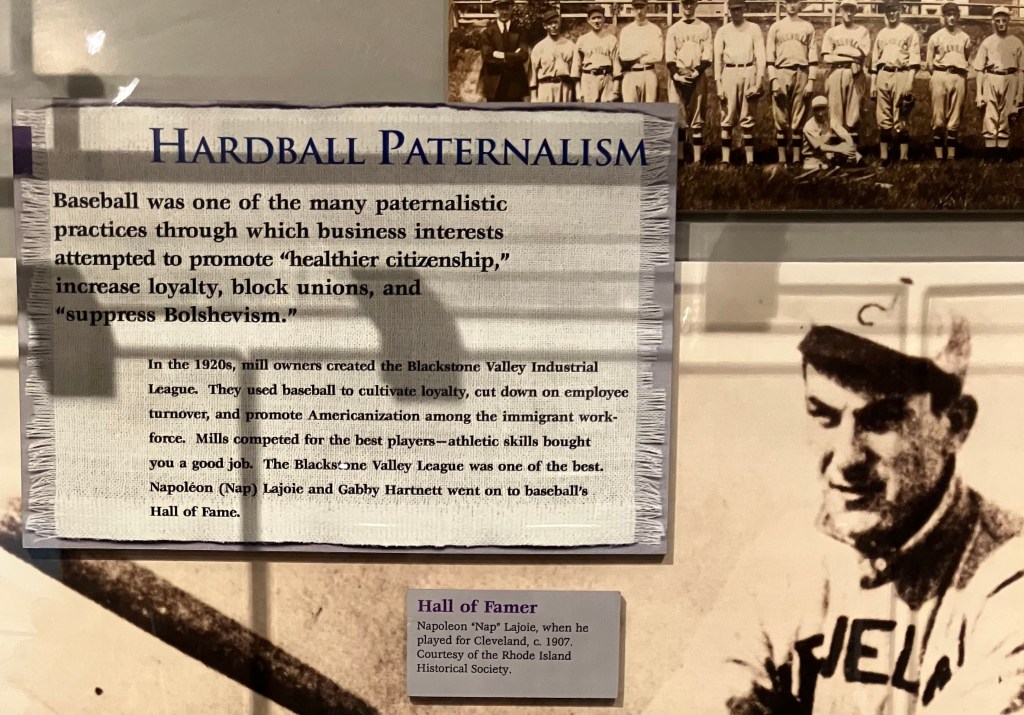
There’s lots of information about working conditions, including child labor, and some of the ways companies tried to keep workers from unionizing, like organizing baseball teams to “promote ‘healthier citizenship,’ increase loyalty, block unions and ‘suppress Bolshevism.'” And there’s a whole room devoted to the history of the Independent Textile Union (ITU) that was organized in Woonsocket during the early years of the Great Depression.
These two museums gave me a taste of the Blackstone Valley’s history, and as I drove home, I was more aware of condo complexes and shopping centers that appeared to be converted mills, as well as the triple decker homes that were originally built to efficiently house workers. The whole area is called the Blackstone River Valley National Heritage Corridor, and there’s more industrial history to explore as well as lots of outdoor activities in and along the river.
Books to read
A couple years ago I put together a Labor Day list of books that celebrate workers from different times and places. They’re all books that I’ve reviewed on my other blog A Kids Book a Day, and I’ve tried to keep the list updated.
One more that’s specific to the area is Mill by David Macaulay (Clarion Books, 1989, 128 pages). Macaulay lived in Rhode Island when he created this book and spent a year researching and studying the old textile mills there. He’s created stories about three fictional mills, and his trademark detailed illustrations will show you all you need to know about how they were constructed and operated.
Stonewall: A Building. An Uprising. A Revolution. by Rob Sanders, illustrated by Jamey Christoph (Random House, 2019, 40 pages). This picture book is narrated by the building, originally a stable built in the 1840’s, that on June 28, 1969, became the site of one of the most well-known events in the gay rights movement. When I reviewed this book in 2019, it introduced me to an event that I knew almost nothing about. Fast forward almost exactly six years, when a trip to NYC led me to visit this famous inn.
I arrived in New York City in the middle of a very hot July Wednesday. After checking in at Penington Friends House (highly recommended for a reasonably-priced NYC stay), I took a fifteen-minute subway ride to Christopher Street in Greenwich Village, where I dove into Stonewall’s history at the Stonewall National Monument Visitor Center, right next to the inn. It’s a pretty small space, but it’s packed with information, not only about Stonewall, but also other LGBTQ+ protests from the era.
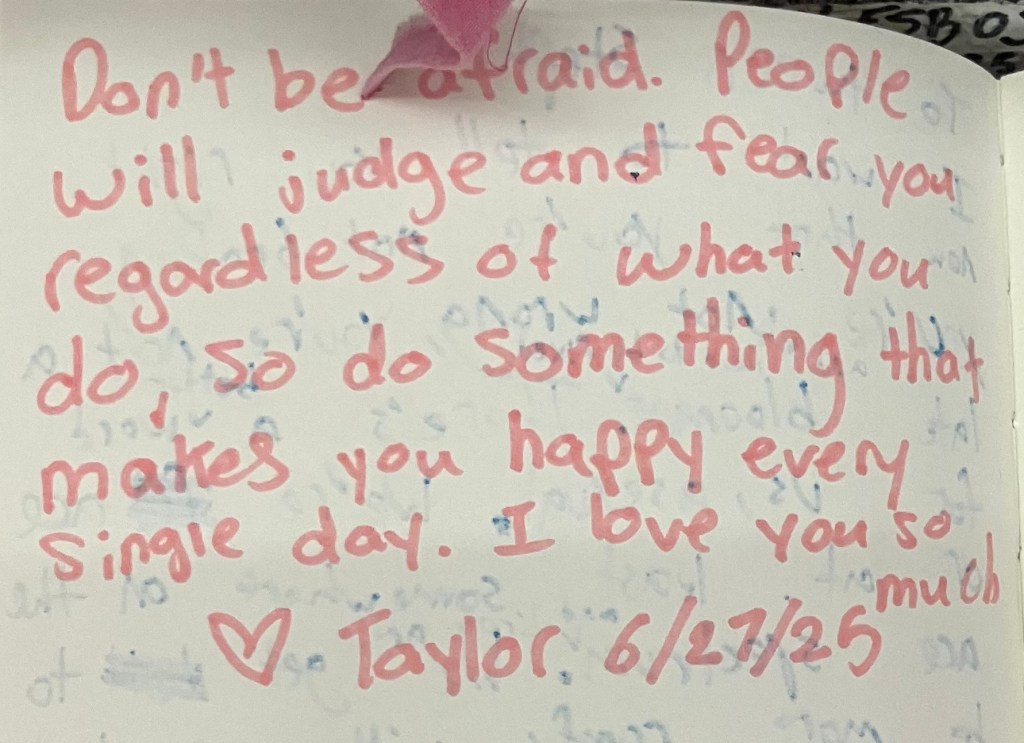
The history of the Stonewall uprising is told in panels along one wall., along with personal accounts from people who were there on the night of the uprising. In front of these panels is a replica of the Stonewall Inn’s jukebox, with a collection of music curated by DJ Honey Dijon to celebrate the spirit of joy and rebellion at the Stonewall. On the other side of the room a collection of notebooks inviting people to write about their own experiences, like this one called, “To…your younger self,”. Reading these personal notes shows how the movement started by Stonewall continues to impact people today, as well as the work that still needs to be done.
Across the street, you can enjoy Christopher Park, a small park with benches around its perimeter that’s home to artist George Segal’s “Gay Liberation” statues of a pair of couples: two men standing and two women sitting. Created in 1980, their installation was (surprise) delayed by controversy until 1992. When I visited in July there was a photo exhibit on the fence outside the park of early LGBTQ+ activists, although this National Park Service site says the exhibit ended in May, so it may be gone.
And finally, if you are over 21, you can go into the Stonewall Inn itself, which I did, although at 3:00 on a Wednesday afternoon, I was the only patron at the bar (relax, I ordered a seltzer with lime). I joined a couple other people sitting outside with their drinks and enjoyed the laid-back city atmosphere. Although its legacy as a gay bar lives on, Stonewall feels quite gentrified, as does the Greenwich Village neighborhood, and you’ll get a better sense of the history at the visitor center.
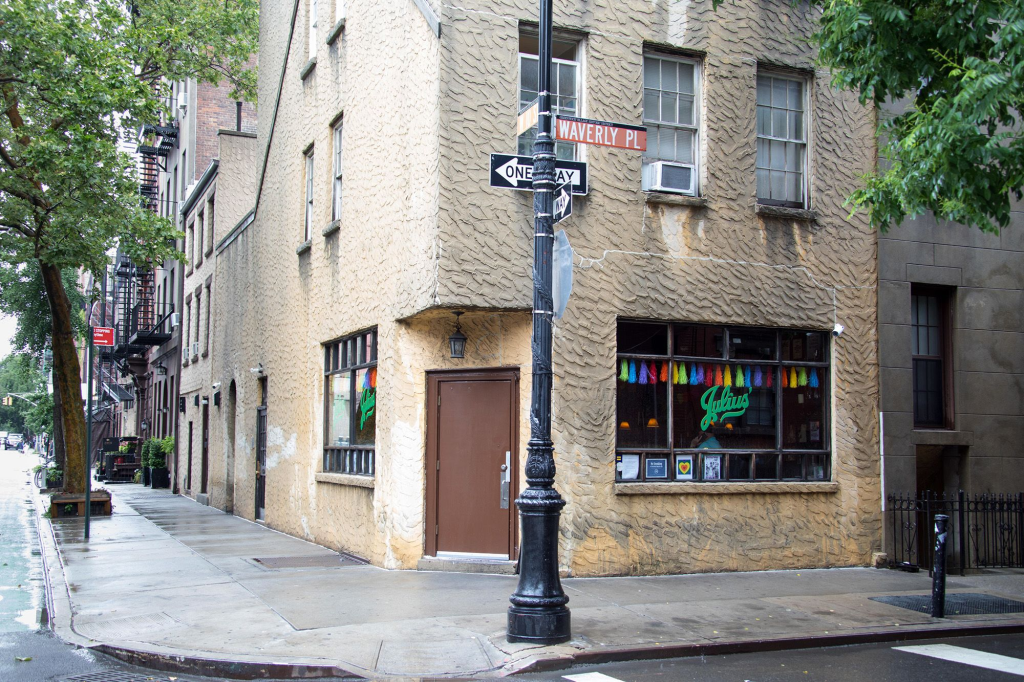
If you have time, you can go back in time a few more years and visit the site of another protest, Julius Bar, just a couple minutes away from the Stonewall Inn. On April 21, 1966 a Sip-In organized by the early gay-rights group, the Matttachine Society. took place, when three members, after identifying themselves as gay, were refused service. The publicity around this event and subsequent court case resulted in a ruling in favor of gay people’s right to assemble.
Books to read
The Stonewall Riots: Making a Stand for LGBTQ Rights by Archie Bongiovanni, illustrated by A. Andrews (First Second, 2022, 128 pages). Part of the History Comics series, this book follows teens Natalia and Jax when they go back in time with Natalia’s abuela to the 1969 night of the Stonewall uprising. A fun introduction for older elementary and middle school kids.
The Stonewall Riots: Coming Out in the Streets by Gail E. Pitman (Abrams Books for Young Readers, 2019, 208 pages). Told through the stories of 50 objects, this book traces the gay liberation movement before and after Stonewall, as well as detailing the riots. Excellent for middle school and up, it could be read from cover to cover or browsing through the different stories.
Pride: The Story of Harvey Milk and the Rainbow Flag by Rob Sanders, illustrated by Steven Salerno (Random House Books for Young Readers, 2018, 48 pages). Although this isn’t about Stonewall, it tells the story of Harvey Milk, an important activist in the LGBTQ+ rights movement and the flag that has become its best-known symbol. All ages.
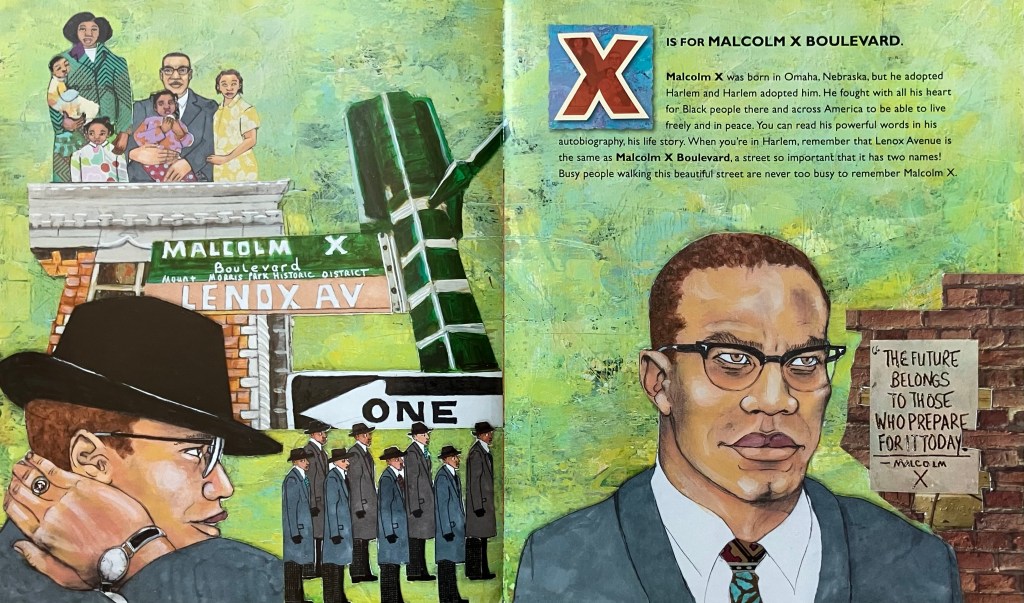
In September of 2022, I reviewed a book called H is for Harlem by Dinah Johnson (Christy Ottaviano books, 2022, 48 pages) and said that I was “ready to hop on the train and take a trip to Harlem.” I had thought I knew a little about this New York City neighborhood and the Harlem Renaissance, but this book showed me that there were many interesting people and places there that I knew nothing about. It took me almost three years, but this summer I finally did got to travel there and visit a few of those places. The list below shows each site I visited, accompanied by a page from this book.
I kept discovering more and more amazing children’s books about Harlem, so this post is a little heavier on the book lists than most. If you’re planning to visit Harlem with kids, read some of these books beforehand to enhance your trip.
H is for Harlem
My trip really just scratched the surface of this Manhattan neighborhood which has a long history, going back to when the Wecquaesgeek inhabited land that would eventually be taken over by the Dutch, who called it Haarlem. Over the years it’s been home to many groups, including Jewish and Italian immigrants, but it’s probably best known for the Harlem Renaissance, which, from just after World War I until the Great Depression, produced an amazing who’s who of writers, musicians, artists, and performers.
Harlem is located in northern Manhattan, with a few different definitions of its boundaries. I visited Central Harlem, bounded by Central Park North, Fifth Avenue, Edgecombe Avenue, and 155th Street. There’s also East Harlem, which is sometimes called Spanish Harlem, and West Harlem, which includes Manhattanville, Sugar Hill, and Morningside Heights.
Books to Read
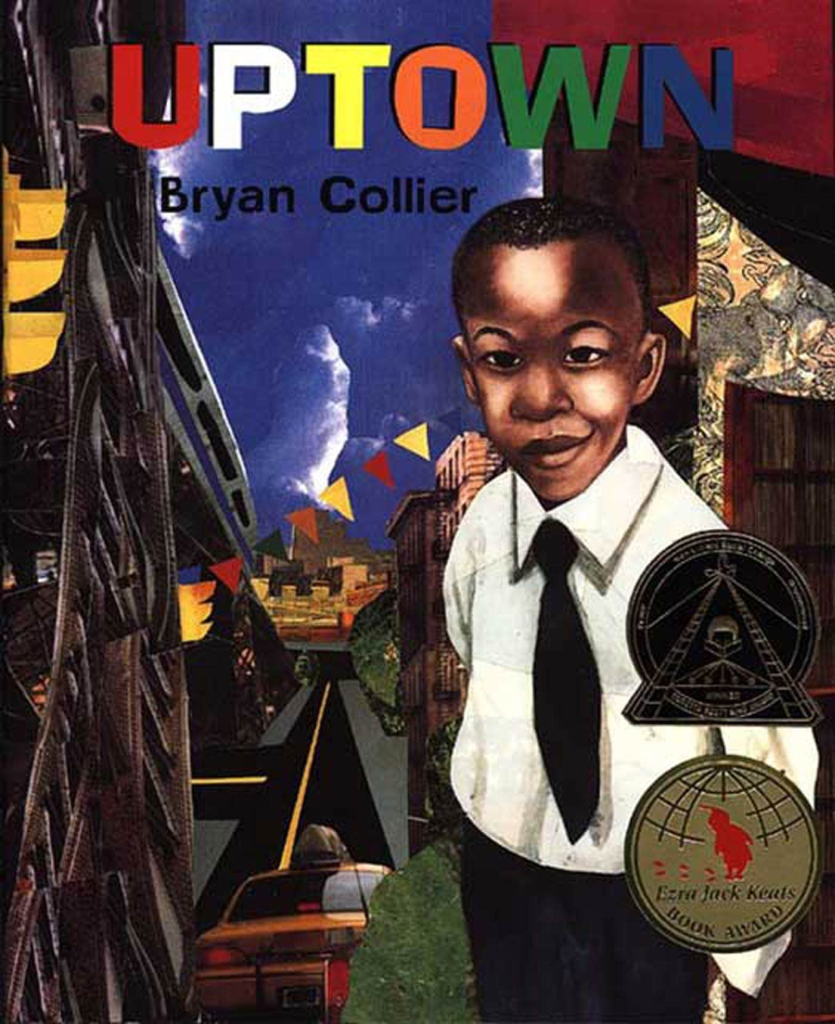
Uptown by Bryan Collier (Henry Holt, 2000, 32 pages). This book is now 25 years old, but it still really captures the vibe of Harlem with its beautiful collage illustrations that are like snapshots of people and places in Harlem where Collier made his home (and as near as I can tell, still does).
Harlem at Four by Dr. Michael Datcher, illustrated by Frank Morrison (Random House Studio, 2023, 48 pages). Dr. Datcher usually writes books for adults, but his four-year-old daughter, Harlem, inspired him to write this two-part picture book. Part one celebrates his days with Harlem in New York City, enjoying art and music by Black artists. The second part is about the fourth year of the twentieth century (1904), when Philip A. Payton, Jr. started the Afro-American Realty Company that bought homes in Harlem and rented them to “brownstone-colored families,” starting the Harlem chapter of the Great Migration that eventually led to the Harlem Renaissance..
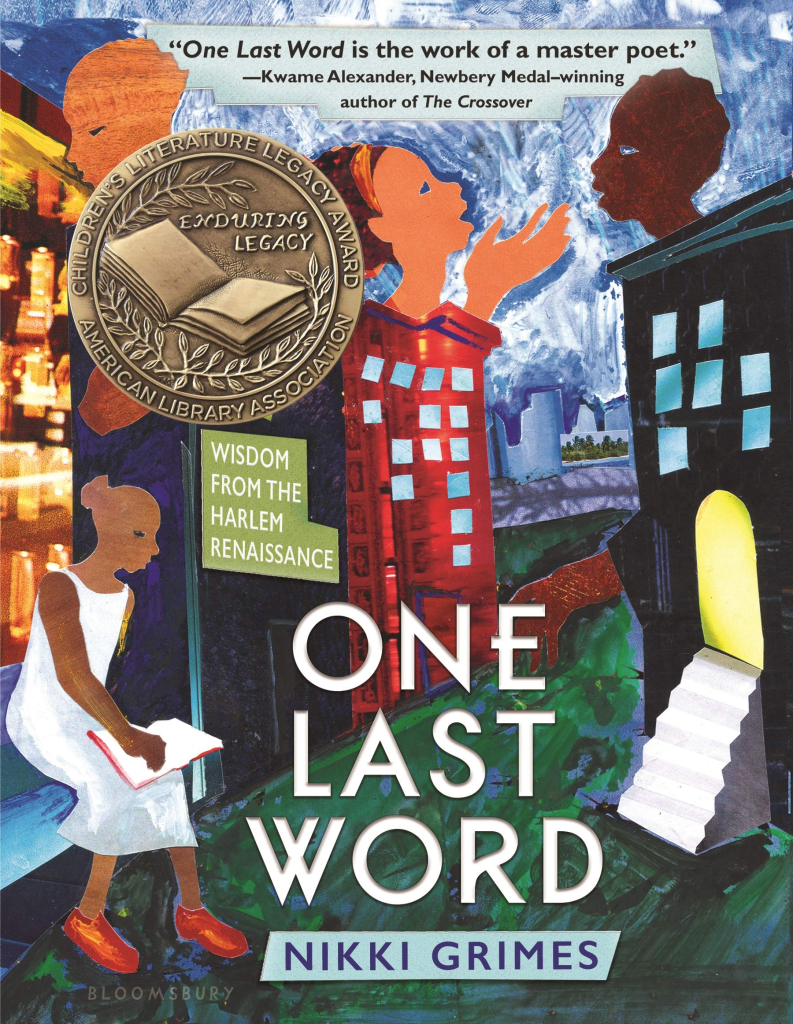
One Last Word: Wisdom from the Harlem Renaissance by Nikki Grimes (Bloomsbury, 2021, 128 pages) and its follow-up Legacy: Women Poets of the Harlem Renaissance (Bloomsbury, 2021, 144 pages). Nikki Grimes wrote her own poems based on the works of Harlem Renaissance poets in these two volumes. They not only serve as amazing introductions to all the poets, but showcase the talents of many contemporary Black artists with the illustrations that accompany the poems. The introductions and back matter offer more information about the Harlem Renaissance and the poets who were part of it.
Harlem Honey by Tamron Hall, illustrated by Ebony Glenn (HarperCollins, 2025, 40 pages). This new book by journalist Tamron Hall tells the story of a boy who’s recently moved from Texas to Harlem. When he discovers neighbors raising bees on the roof, he makes a new friend and gets introduced to Sylvia’s, the Apollo Theater, and other Harlem landmarks. The story plus the additional information at the end make this a good introduction to Harlem for younger elementary kids.
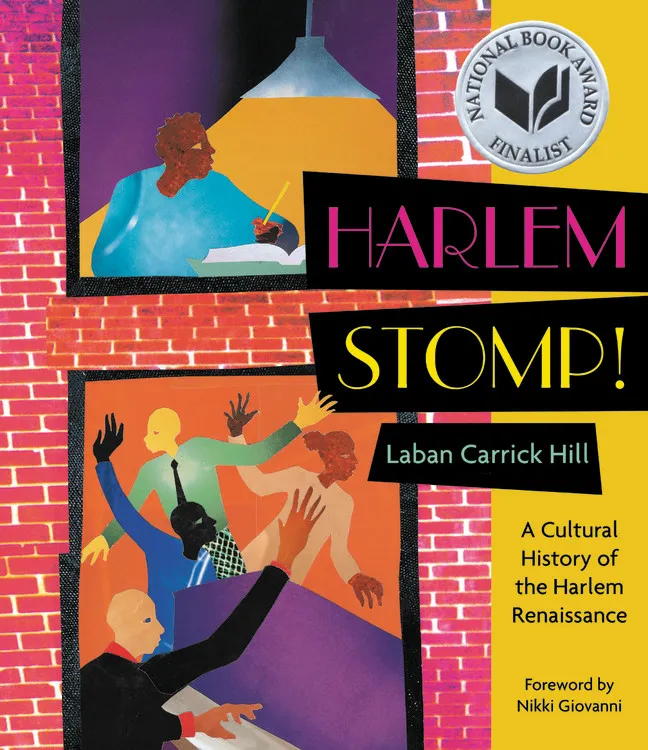
Harlem Stomp!: A Cultural History of the Harlem Renaissance by Laban Carrick Hill, foreword by Nikki Giovanni (Little, Brown Books for Young Readers, 2004, 160 pages). This National Book Award finalist gives a pretty complete history of the Harlem Renaissance in a format that can be read cover-to-cover or browsed through for topics of interest. Readers in middle school and high school will get a lot of background that would be useful to know before visiting Harlem.
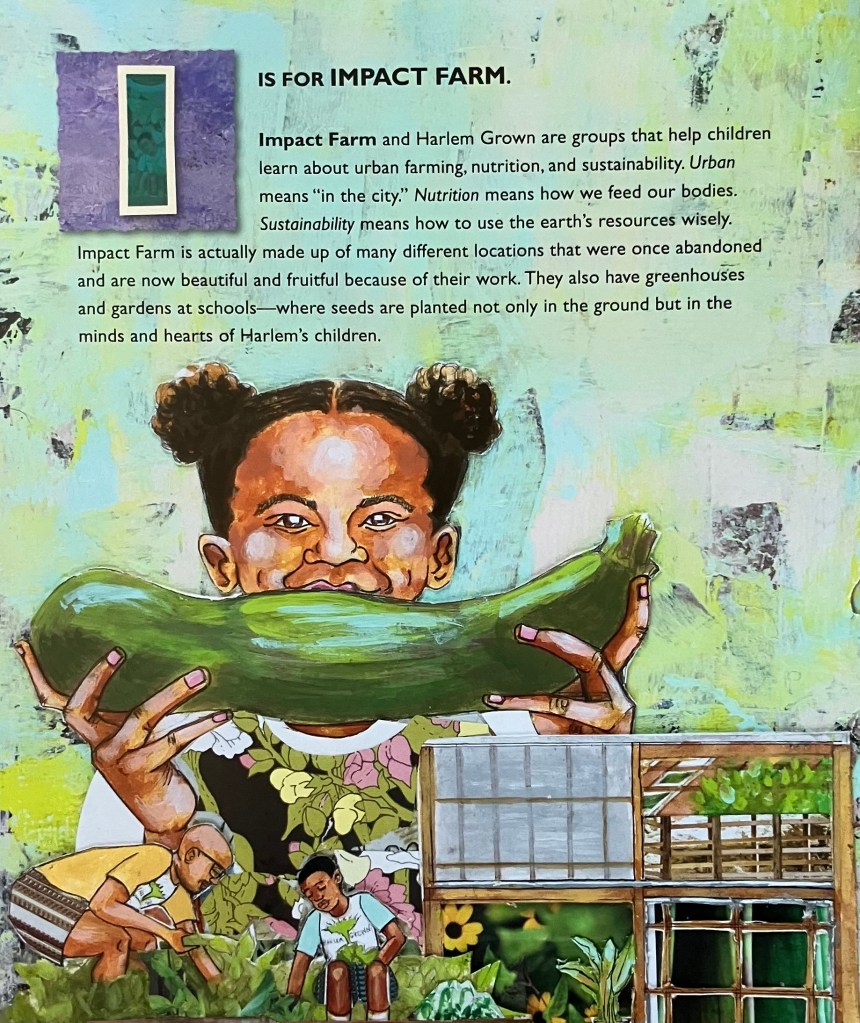
I is for Impact Farm
This page of the book mentions Impact Farm and Harlem Grown as groups that teach kids about urban farming. I can’t find any information about Impact Farm, and when I Google it, I get results for Harlem Grown. I found Harlem Grown on my visit, and strolled around. Their gardens were flourishing, and they also have a chicken coop and a cool little round library where kids and their caregivers can sit and read together about farming and cooking. Check out their website for events and free farm stands around the city.
Books to Read
Harlem Grown: How One Big Idea Transformed a Neighborhood by Tony Hillery, illustrated by Jessie Hartland (Simon and Schuster/Paula Wiseman Books, 2020, 40 pages). Tony Hillery tells how his volunteer work at P.S. 175 led to him turning the vacant lot across the street into Harlem Grown. He’s been helped by many others, and some of their work is described in the sequel, Saturdays at Harlem Grown: How One Big Idea Transformed a Neighborhood by Tony Hillery, illustrated by Jessie Hartland (Simon and Schuster/Paula Wiseman Books, 2024, 48 pages). It shows the chicken coop and the library, as well as the garden! Both of these are great introductions that will appeal to preschool and up, and there’s lots of back matter to give older readers additional information.
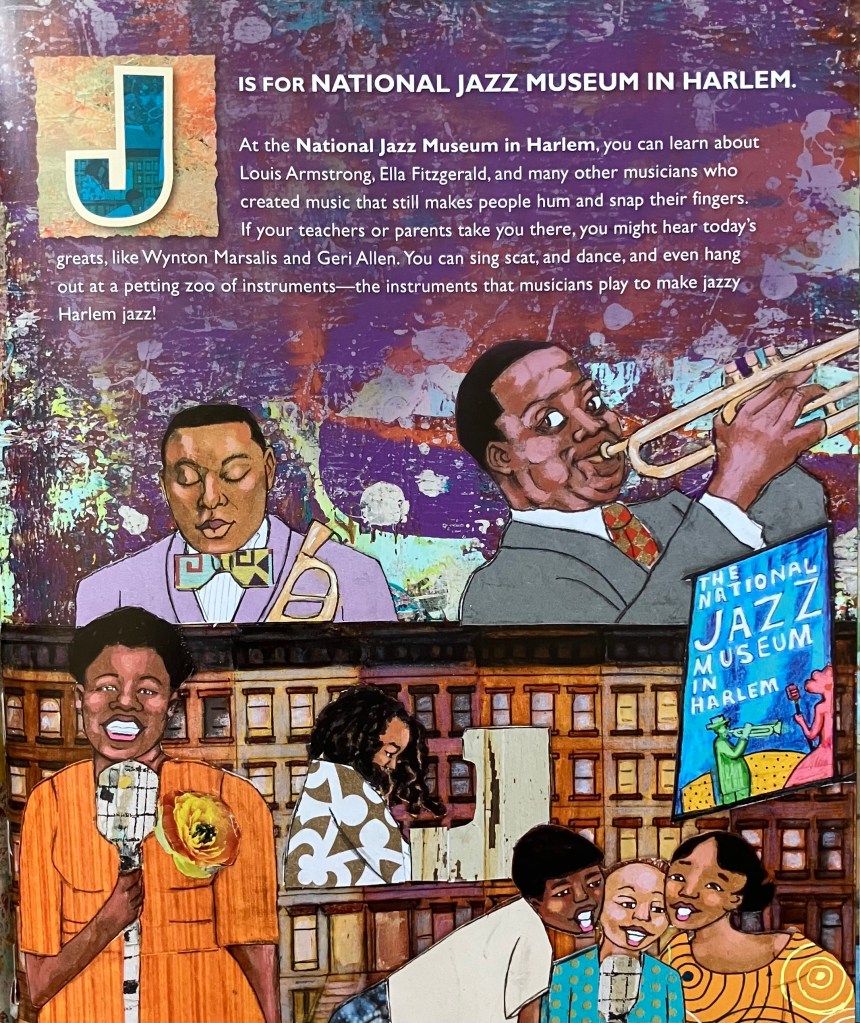
J is for National Jazz Museum in Harlem
I’m the first to admit that I know next to nothing about jazz, but I still enjoyed this small museum about one of Harlem’s best-known musical genres. Duke Ellington’s piano is front and center, which is pretty cool, and there’s a lot of information about the impact of Latinx musicians from Puerto Rico, Cuba, and other places on jazz. There’s also a fun interactive exhibit where you can try your hand at playing piano with some of the greats, but I knew my limitations.
Books to read
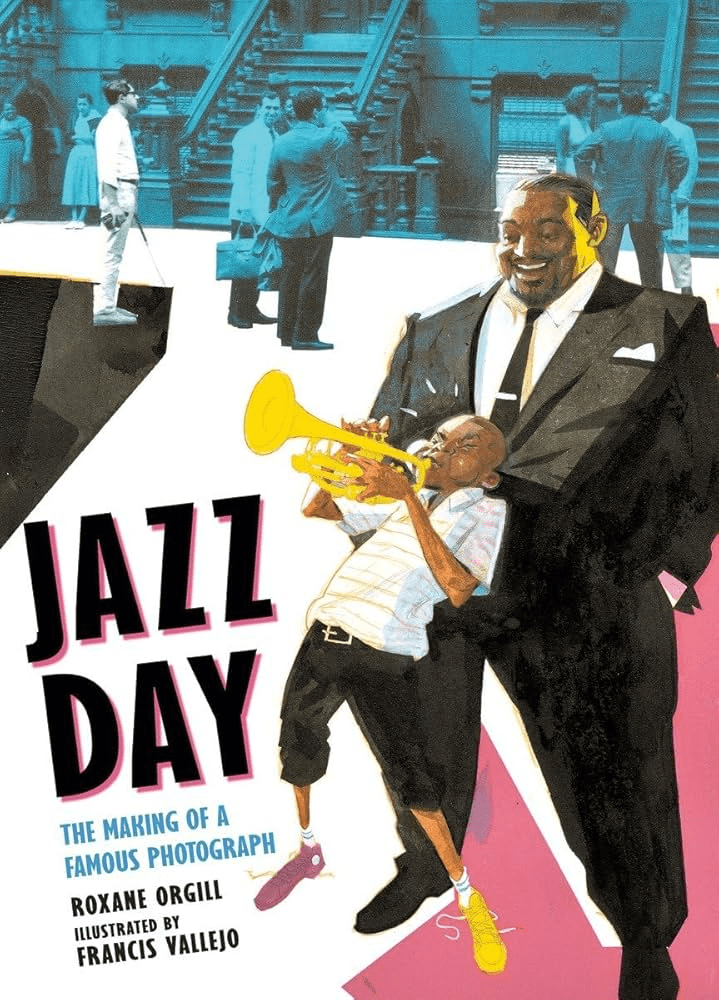
Jazz Day: The Making of a Famous Photograph by Roxane Orgill, illustrated by Francis Vallejo (Candlewick, 2017, 66 pages). Poems in the voices of jazz musicians, observers, and photographer Art Kane tell the story of Kane’s idea to photograph 57 jazz artists in front of a Harlem brownstone on August 12, 1958, which was published in Esquire magazine as A Great Day in Harlem. A bunch of local kids lined up to be in the front row of the photo. Biographies of all the musicians in the photo at the end of the book bring their stories to life and will enhance the visit to the Jazz Museum.
¡Mambo Mucho Mambo!: The Dance That Crossed Color Lines by Dean Robbins, illustrated by Eric Velasquez (Candlewick, 2021, 40 pages) shows how Latin jazz, starting in Spanish Harlem and later moving to the Palladium, brought together dancers from all different neighborhoods and created a new type of dancing that led to greater integration of dance clubs.
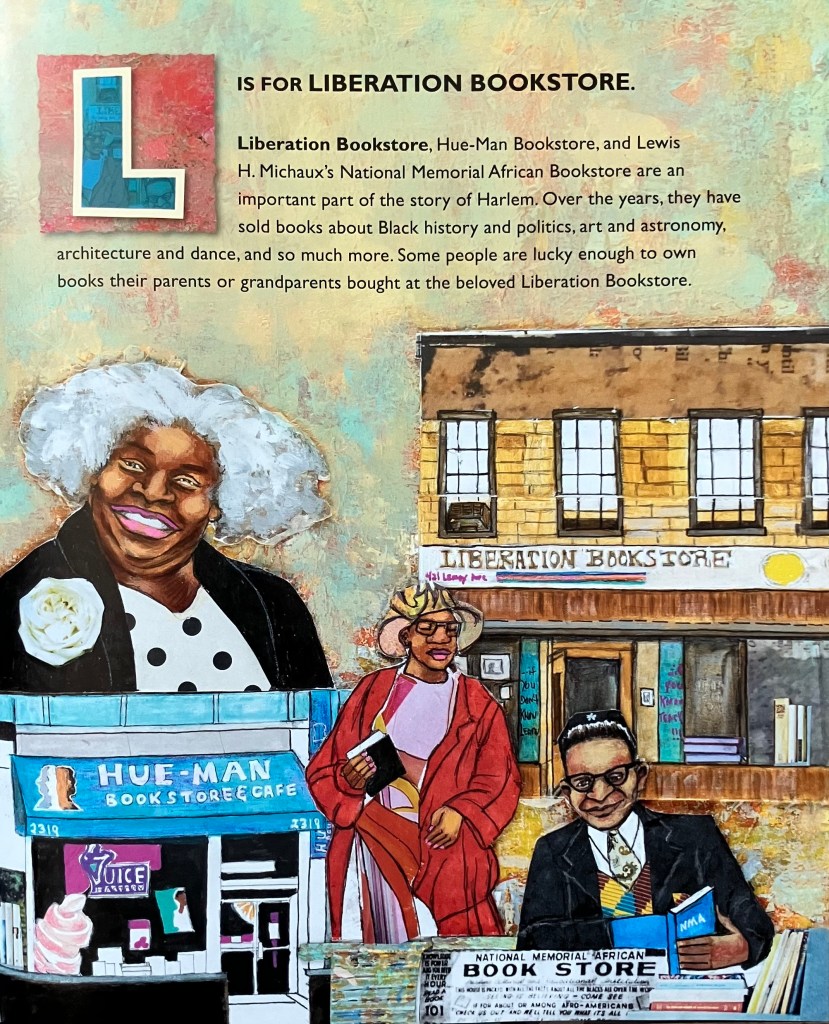
L is for Liberation Bookstore
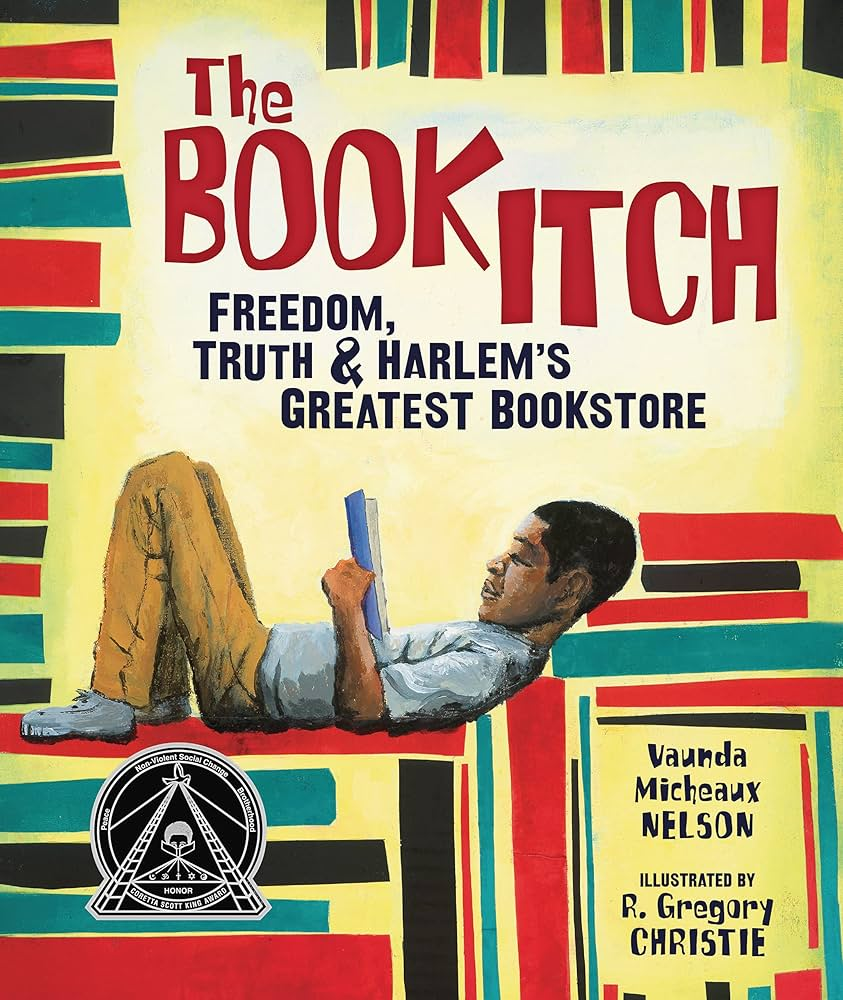
The bookstores listed in H Is for Harlem include Liberation Bookstore, run by Una Mulzac from 1967 to 2007, National Memorial African Bookstore, Lewis H. Michaux’s bookstore that was on 7th Avenue from 1932-1968 before moving to West 125th Street until it closed in 1974, and Hue-Man Bookstore, whose owner, Marva Allen, closed the doors in 2012 after a decade in business (although Hue-Man still has an online presence as Huemanbooks and partners with Ground Central Coffee for events).
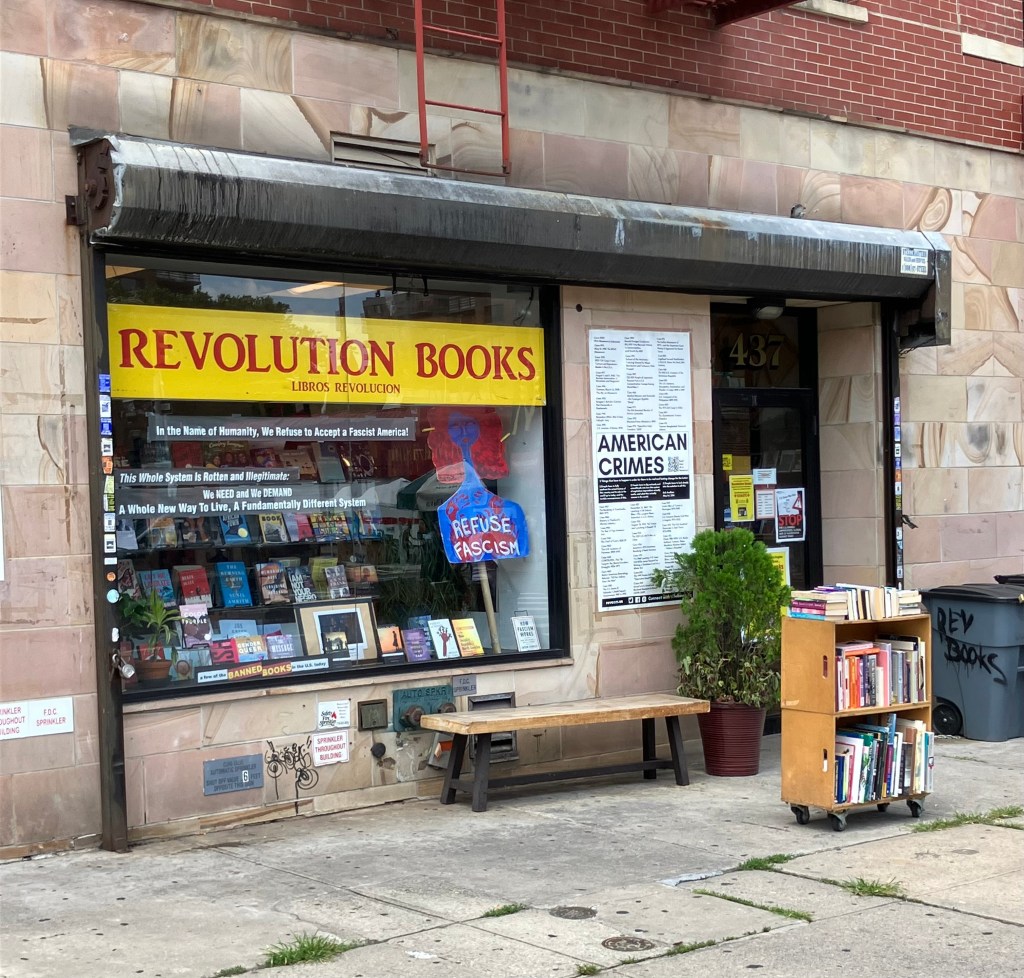
If you want a taste of these activist former bookstores, I recommend stopping by Revolution Books. Not only do they have an excellent selection of interesting books to educate readers of all ages about various leftist causes, but it was probably the friendliest place I found in Harlem. There were several volunteers hanging out, and they were interested to hear what brought me there, and eager to talk to me about Communism, specifically Bob Avakian and his Revolutionary Communist Party. I very much enjoyed our conversation and was persuaded to buy a $5.00 paperback about Avakian.
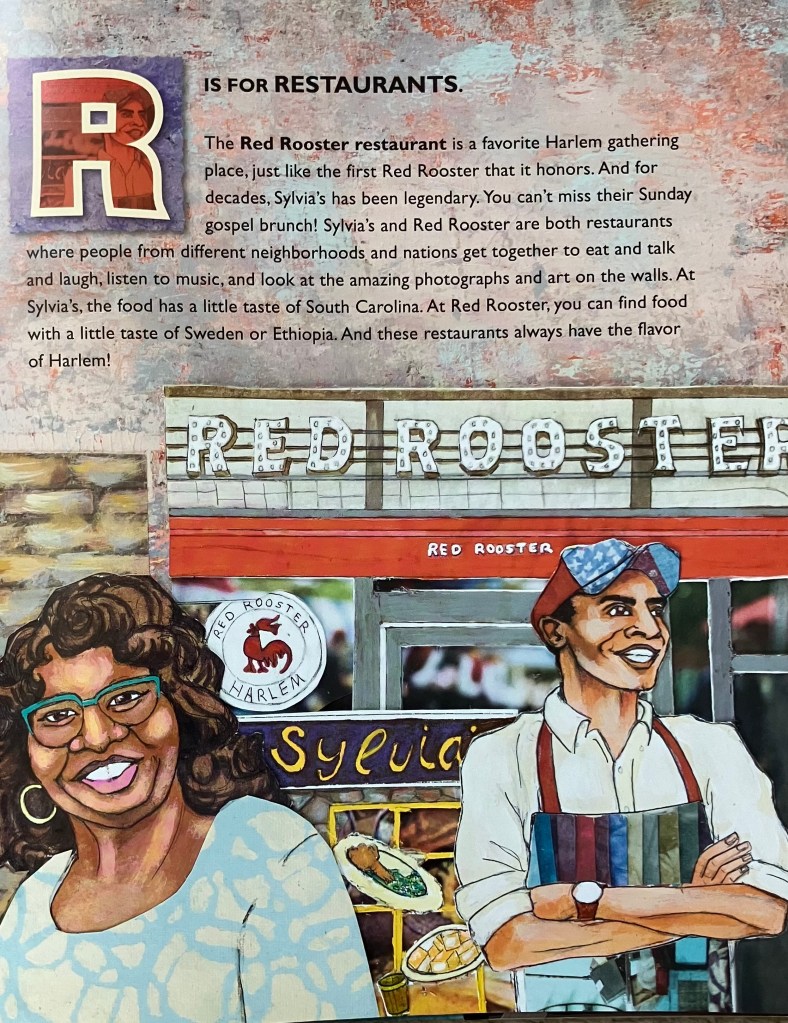
The two restaurants listed in the book are Sylvia’s and the Red Rooster. Sylvia Woods bought Johnson’s Luncheonette, where she was working as a waitress, in 1962, and turned it into a soul food restaurant that’s fed ordinary folks and celebrities like Quincy Jones, Diana Ross, and Presidents Clinton and Obama.
I went to Sylvia’s only because it opened an hour earlier and fit my schedule better, but I was so glad I did! There’s a nice lunch menu with reasonable prices and good-sized portions. I ordered the smothered chicken leg with a side of macaroni and cheese, which was delivered to my table in about two minutes by my gracious and attentive server. The chicken, lightly fried and smothered in gravy, was tenderly slipping off the bone, and the macaroni was a cheesy marvel with just the right amount of crustiness on top. As if this weren’t enough, I also got two mini loaves of warm cornbread with butter. There are photos of celebrities who have dined at Sylvia’s adorning the walls, but the atmosphere is very down-to-earth and homey.
I did walk by the Red Rooster, which is just a couple of doors down, and the menu there looked delicious, if a bit more sophisticated. A little research revealed that it’s better known for its celebrity head chef Marcus Samuelsson than for the historical significance of Sylvia’s. The name is taken from a more historical restaurant, which I’m guessing is what’s referenced in the book, but I couldn’t find much about it..
Book to read
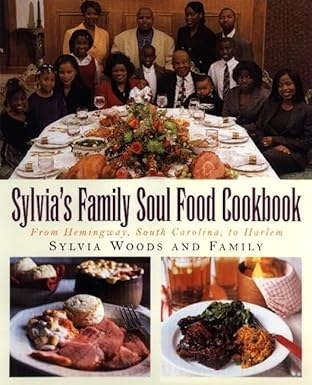
Sylvia’s Family Soul Food Cookbook: From Hemingway, South Carolina to Harlem by Sylvia Woods (William Morrow, 1999, 288 pages). I haven’t tried any of the recipes, but I did read the 66-page introduction, which gave me a whole new appreciation for Sylvia Woods and her restaurant. Learning about her childhood in Hemingway, South Carolina helped me to understand not only where her incredible menu came from, but also the strong women and hard work that were influential in her success. Her maternal grandfather was lynched when her mother was a baby, and her own father died as a result of World War I gassing when Sylvia was three days old, but her mom and grandmother worked hard, persevered, and passed along a love of food to nurture both body and soul that you can still taste at the restaurant today.
S is for Schomburg Center for Research in Black Culture
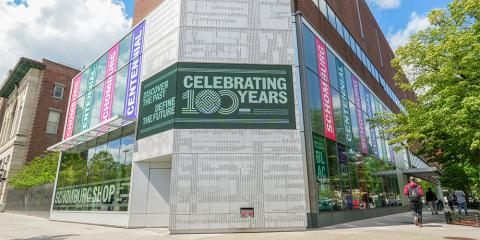
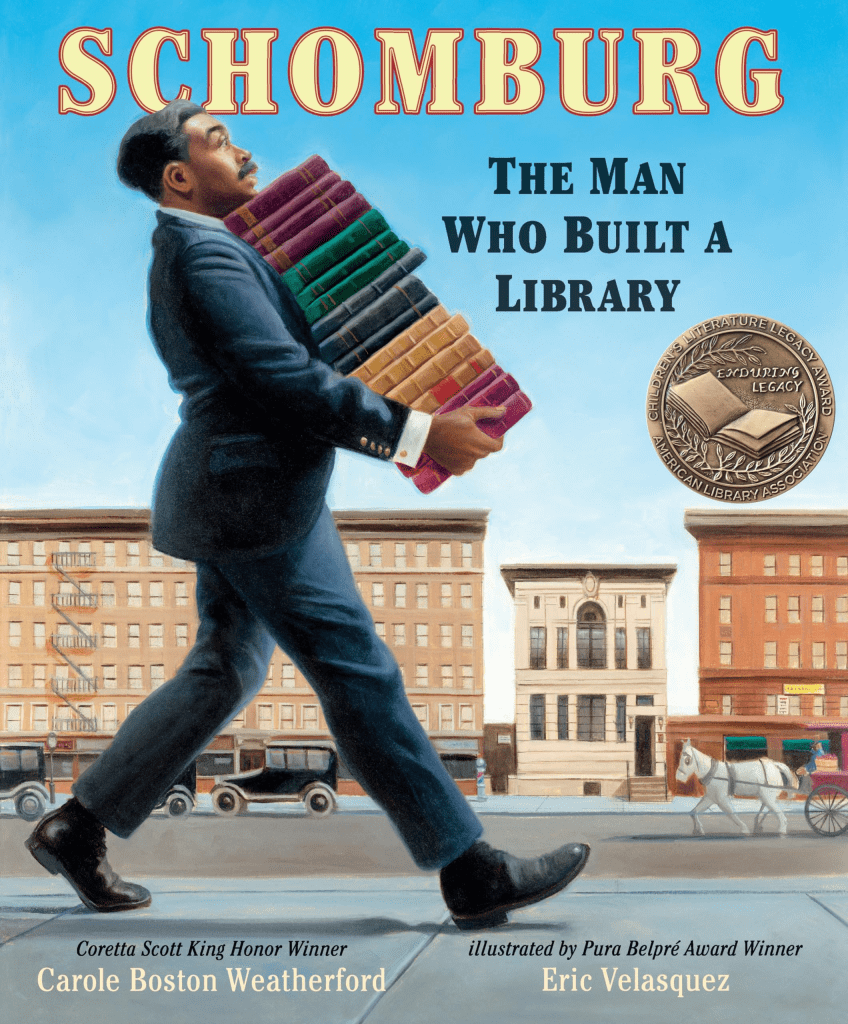
This is where I started my day, and it was a perfect first stop. Arturo Schomburg grew up in Puerto Rico with a Black mother and a white father. When one of his elementary school teachers claimed that Black people had no history, Schomburg embarked on a lifelong quest to disprove this. He accumulated an amazing collection of books and papers that was eventually acquired by the 135th Street Branch of the New York Public Library. Librarian Ernestine Rose sought to uplift and preserve the Black and Latinx cultures of the 135th Street library where she worked and was a key player in purchasing Schomburg’s collection for this library, which later became known as the Schomburg Center for Research in Black Culture.
I enjoyed taking in all the exhibits, particularly the handwritten manuscripts from such writers as Maya Angelou, James Baldwin, and Malcolm X. Seeing Baldwin’s scrawled outline for Go Tell It On the Mountain or Angelou’s handwritten page with lots of words crossed out made them seem more human, struggling to express themselves like the rest of us. I accidentally wound up behind a touring group of Black teens, and got to enjoy hearing their older tour guide proudly telling them about the achievements of the people celebrated in the exhibits.
Books to read
There Was a Party for Langston by Jason Reynolds, illustrated by Jerome Pumphrey and Jarrett Pumphrey (Atheneum/Caitlyn Dlouhy Books, 2023, 56 pages). Inspired by a photo of writers Maya Angelou and Amiri Baraka dancing together at a 1991 party honoring Langston Hughes held at the Schomburg Library, this is an exuberant celebration of Black writers inspired by Hughes. I just reread this book and felt like my visit to Harlem and the Schomburg really enhanced my understanding of it versus my first reading in 2023.
Schomburg: The Man Who Built a Library by Carole Boston Weatherford, illustrated by Eric Velasquez (Candlewick, 2017, 48 pages). I hadn’t read this book in eight years, and I forgot what a masterpiece it is, with poetry and oil paintings describing both Arturo Schomburg’s life and many of the people he studied. His painstaking research not only preserved an enormous amount of American Black history, but traced the African roots of such men as John James Audubon and Ludwig van Beethoven. It may be a little over the heads of younger kids, but older elementary and middle school readers will gain a greater appreciation of the Schomburg Center if they can get their hands on this book ahead of their visit.
X is for Malcolm X Boulevard
Almost all my Harlem visits took place on Malcolm X Boulevard. The part of Sixth Avenue north of Central Park was named Lenox Avenue in 1887 to honor philanthropist James Lenox. 100 years later, it was co-named Malcolm X Boulevard in honor of Black activist who lived and worked in Harlem for many years, and was assassinated there in 1964.. The Shabazz Center in the Audubon Ballroom, where Malcolm X made his final speech, is an educational center committed to carrying on the work of Malcolm X and his wife Betty Shabazz.
Books to read
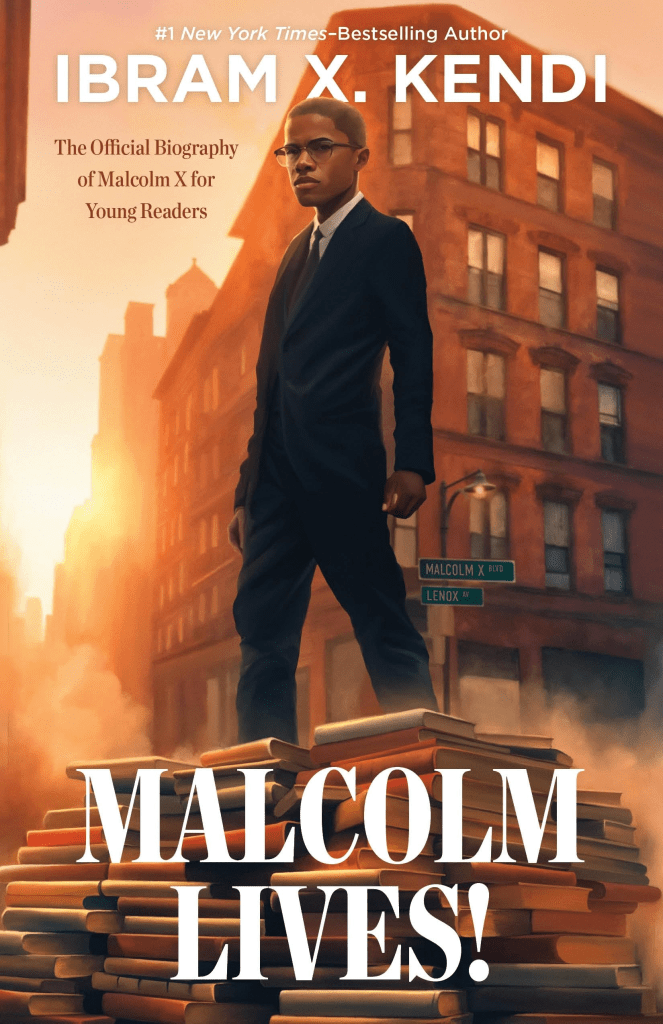
Malcolm Lives!: The Official Biography of Malcolm X for Young Readers by Ibram X. Kendi (Farrar, Straus, and Giroux, 2025, 400 pages). This new book by scholar and activist Kendi has gotten four starred reviews and is on my TBR list. It’s recommended for grades 5 and up.
Malcolm X: A Fire Burning Brightly by Walter Dean Myers, illustrated by Leonard Jenkins (Amistad, 2003, 40 pages). Walter Dean Myers won Coretta Scott King honor for his 1993 young adult biography Malcolm X: By Any Means Necessary (Scholastic, 1993). A decade later, he wrote this picture book, a well-written, straightforward introduction to Malcolm X’s life, perfect for older elementary or middle school kids.
Still on my bucket list
A is for Apollo Theater. I planned to go to Amateur Night on this trip, but I found out right before I left that the Apollo closed in June for a year of renovations.
D is for Dance Theatre of Harlem. I hope to catch a performance someday, either in NYC or on tour.
F is for Figure Skating in Harlem. I thought about going to their spring showcase, but it’s a tough time for me to get to New York. Maybe when I retire….
G is for Harlem Globetrotters. They do come to Springfield, Massachusetts, where I teach. I think my students might appreciate that performance more than I would!
T is for Harriet Tubman. The statue of Harriet Tubman is about a mile from where I spent most of my day. Had it not been nearly 100 degrees outside, I would probably have walked over to see it.




























 The Resistance Files